41 molecular orbital diagram for f2
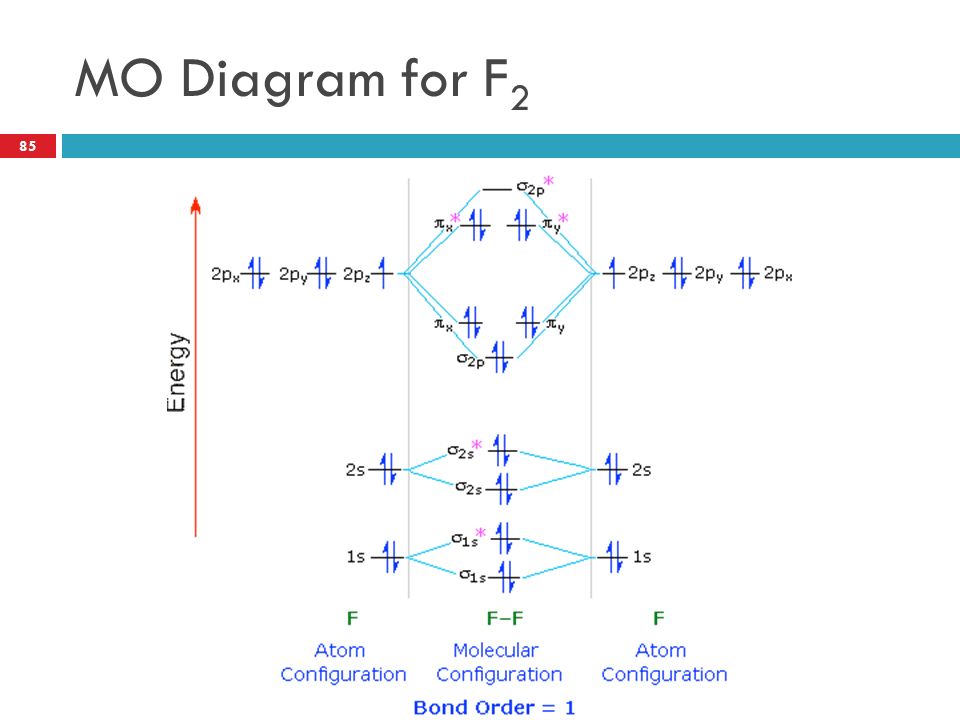
Feb 03, 2022 · The orbital diagram for a diatomic molecule is. To find the bond order, add the 15 electrons in the molecular orbitals (the blue-colored energy levels in the diagram) one at a time until you have used them up. They completely fill all the orbitals except the highest-energy antibonding sigma 2p orbital. Nov 01, 2021 · When we make the molecular orbital energy level diagram of f2 molecule then, we will get this configuration: 1σs 2, 1σ*s 2, 2σs 2, 2σ* 2, σ2pz 2, π2p x 2, π2p y 2, πp x * 2, π2p y * 2. From this electronic configuration, we can see that there are a total of ten bonding molecular orbitals and eight antibonding molecular orbitals.
F2 Molecular Orbital (MO) Diagram As per molecular orbital (MO) theory, all the constituent atoms in a molecule contribute to the formation of molecular orbitals. These MOs are a linear combination of the atomic orbitals. Thus, the electrons in a molecule are not individually assigned to atomic orbitals but to molecular orbitals.
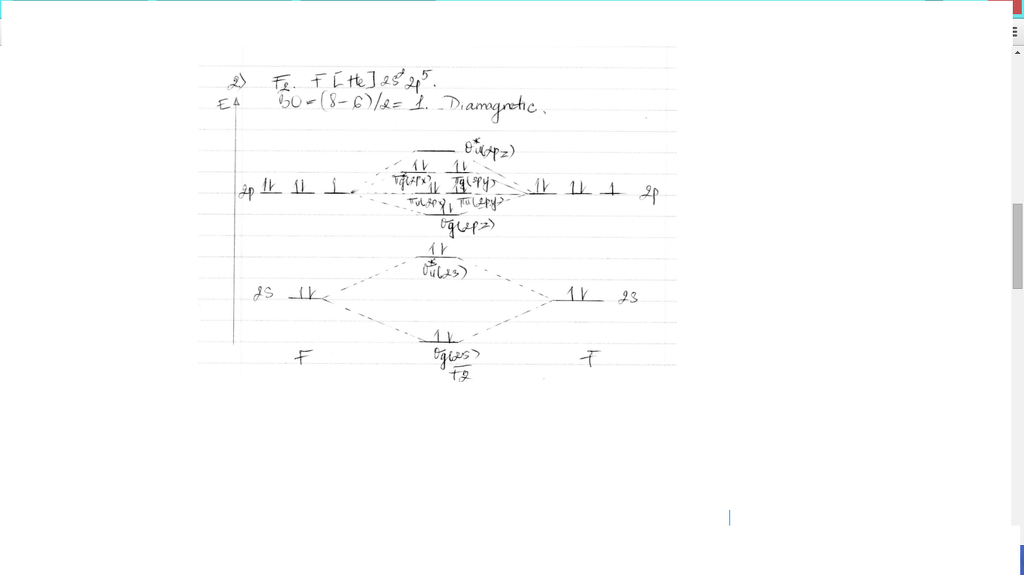
Molecular orbital diagram for f2
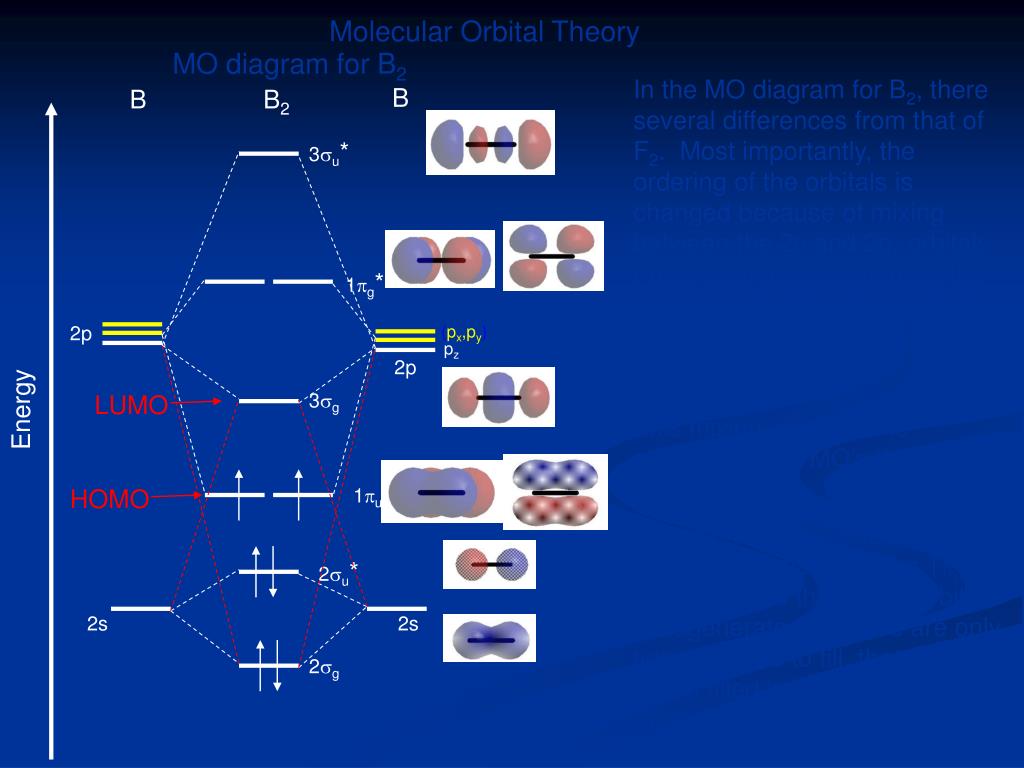
Even rather simple molecular orbital (MO) theory can be used to predict from the bottom of the diagram because this is how MO diagrams are constructed, from N2, O2, F2, Ne2 the complexity of the molecular orbitals develop in two ways. Page 1. MO Diagrams for Elements Li2 through Ne2. (Don't memorize.) Li2 through N2. O2 through Ne2. MO Diagram for HF The AO energies suggest that the 1s orbital of hydrogen interacts mostly with a 2p orbital of fluorine. The F 2s is nonbonding. H-F nb σ σ* Energy H -13.6 eV 1s F -18.6 eV -40.2 eV 2s 2p So H-F has one σ bond and three lone electron pairs on fluorine A molecular orbital diagram, or MO diagram, is a qualitative descriptive tool explaining chemical bonding in molecules in terms of molecular orbital theory in general and the linear combination of atomic orbitals (LCAO) method in particular. A fundamental principle of these theories is that as atoms bond to form molecules, a certain number of atomic orbitals combine to form the same number of ...
Molecular orbital diagram for f2. The molecular orbital diagrams for molecules and ions are drawn from the order of increasing energies shown in the molecular orbital configuration. Always remember that the number of molecular orbitals formed must be equal to the number of atomic orbitals that were combined in the molecule. Draw molecular orbital diagram for F2 molecule. Also, give its electronic configuration, bond order and magnetic property. 138. Solve the following: Open in App. Solution. Verified by Toppr. Solve any question of Chemical Bonding and Molecular Structure with:-Patterns of problems > A) F2; B) F2^2+ C) Ne2^2+ D) O2^2+ E) F2^2-2) Use molecular orbital diagrams to determine which of the following are paramagnetic. A) O2^2-B) Ne2^2+ C) O2^2+ D) F2^2+ E) None of the above are paramagnetic; 3) Draw the molecular orbital diagram needed, and determine which of the following is paramagnetic. Molecular orbital diagram of N 2 BO = [Nb-Na] = [10-4] = 3 Since all the electrons in nitrogen are paired, it is diamagnetic molecule.
Draw the molecular orbital diagram of dioxygen and calculate bond order. Medium. View solution > Explain the molecular orbital structure, bond order, stability and magnetic behavior of Hydrogen molecule on the basis of molecular orbital theory. ... Problem: Use the molecular orbital diagram shown to determine which of the following is most stable.a.F22+b. Ne22+c. F22-d. O22+e. F2 The Molecular Orbital Theory (often abbreviated to MOT) is a theory on chemical bonding developed at the beginning of the twentieth century by F. Hund and R. S. Mulliken to describe the structure and properties of different molecules. The valence-bond theory failed to adequately explain how certain molecules contain two or more equivalent bonds ... Answer (1 of 6): Here is the solution, > * For O2 molecule, > * For F2 molecule, Thanks for reading.
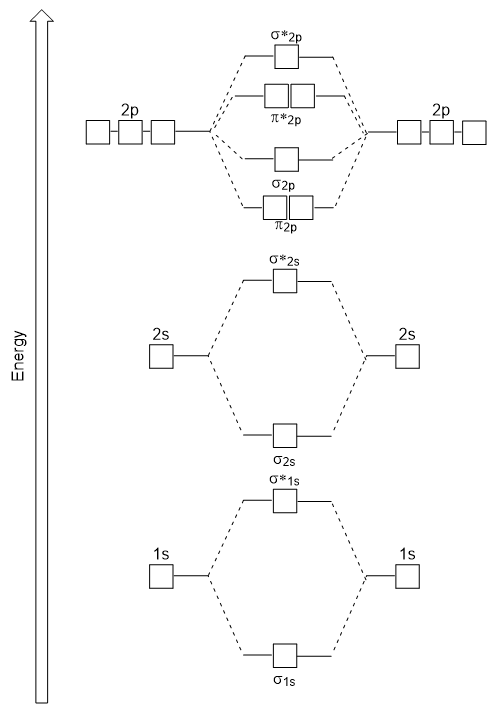
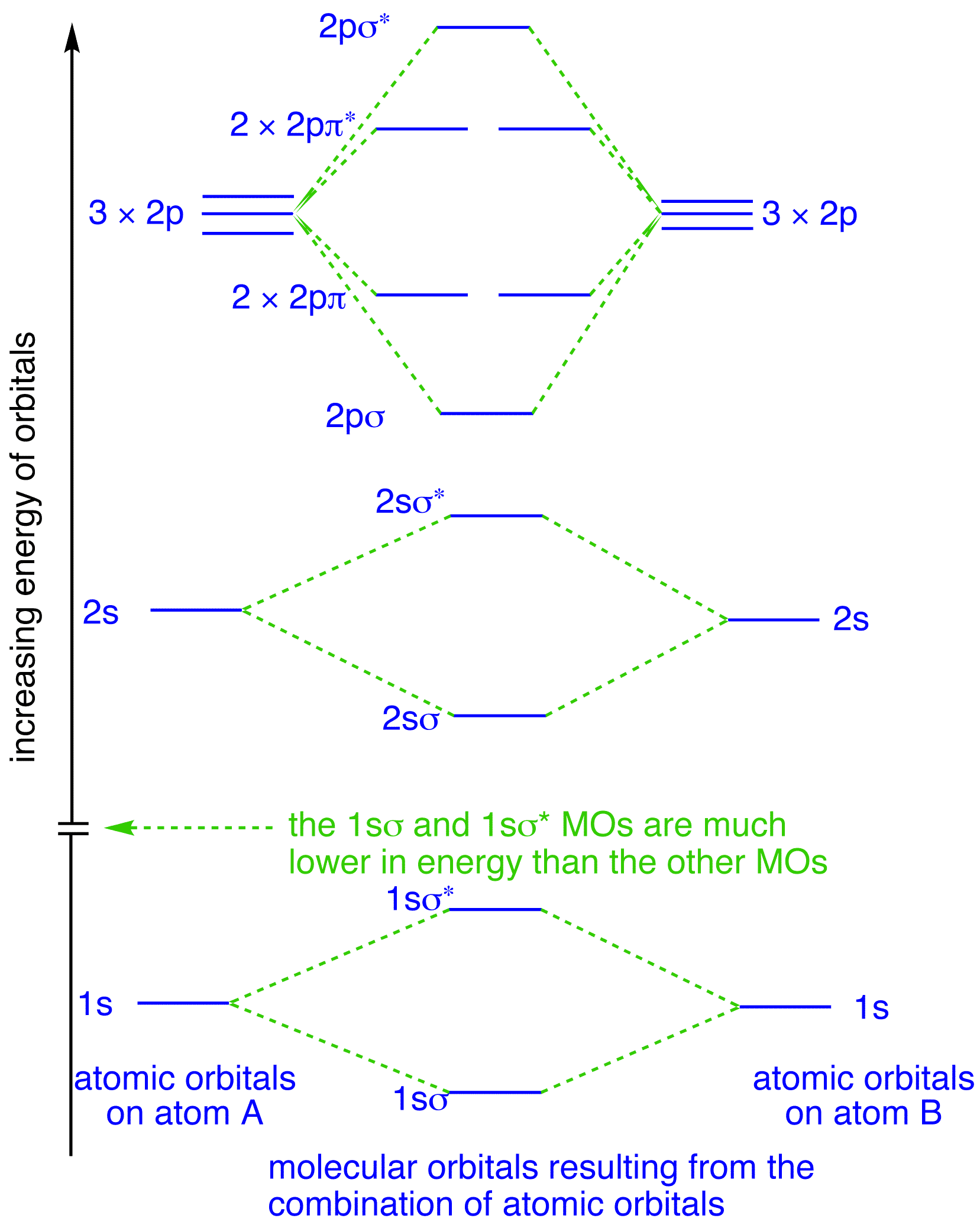
together to produce a sigma molecular orbital [σ = (1sa + 1sb)]. Since the electrons in this orbital are more stable than on the individual atoms, this is referred to as a bonding molecular orbital. A second molecular orbital is also created, which we simplistically show as a subtraction of the two atomic 1s orbitals [σ* = (1sa - 1sb)]. This ... Molecular Orbital Energy Diagrams. The relative energy levels of atomic and molecular orbitals are typically shown in a molecular orbital diagram (Figure 7.7.9). For a diatomic molecule, the atomic orbitals of one atom are shown on the left, and those of the other atom are shown on the right. Electrons are added to molecular orbitals, one at a time, starting with the lowest energy molecular orbital. The two electrons associated with a pair of hydrogen atoms are placed in the lowest energy, or bonding, molecular orbital, as shown in the figure below. This diagram suggests that the energy of an H 2 molecule is lower than that of a ... Draw the molecular orbital (MO) electron diagram for the F2 molecule. Be sure your diagram contains all of the electrons in the molecule, including any core electrons. Question: Draw the molecular orbital (MO) electron diagram for the F2 molecule. Be sure your diagram contains all of the electrons in the molecule, including any core electrons.
Draw the molecular orbital diagram for F2 and find out the ...
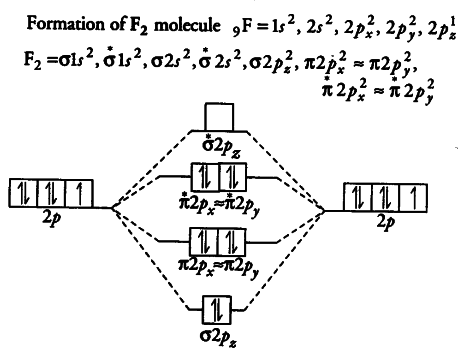
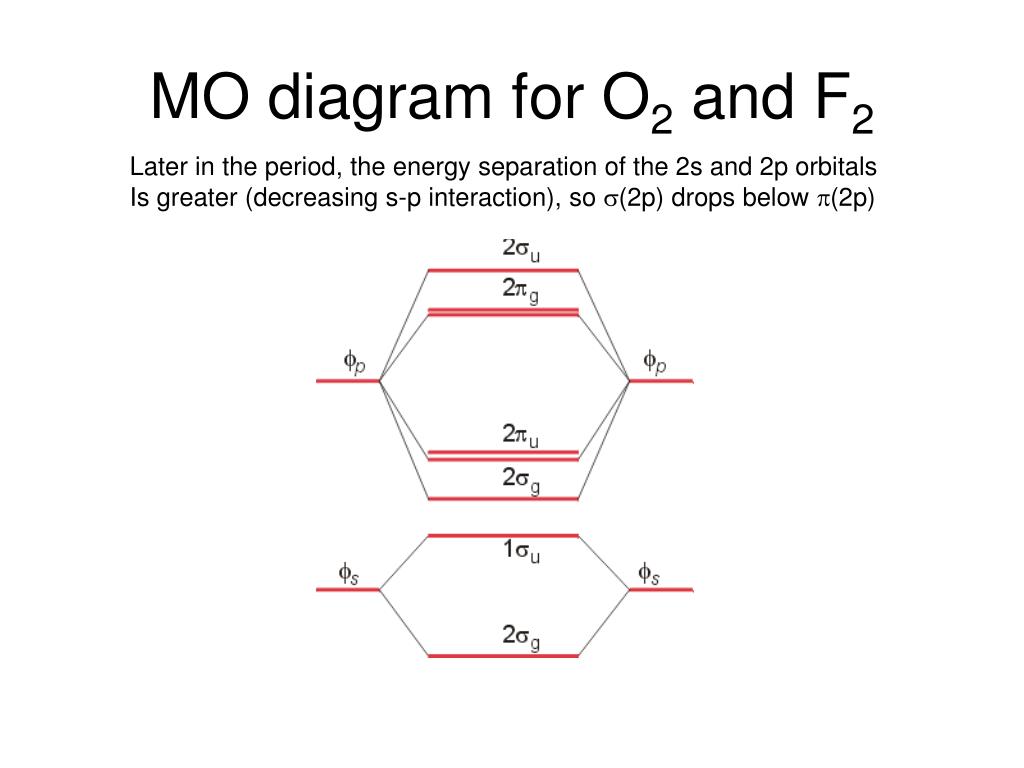
Whereas, presence of unpaired electrons shows that the substance is paramagnetic i.e. can be attracted by magnetic field. Now, let us see the MO diagram of F 2 molecule- -Molecular orbital electronic configuration is given by, MOEC = K K ( σ 2 s) 2 ( σ ∗ 2 s) 2 ( σ 2 p z) 2 [ ( π 2 p x) 2 = ( π 2 p y) 2] [ ( π ∗ 2 p x) 2 = ( π ∗ 2 p y) 2]
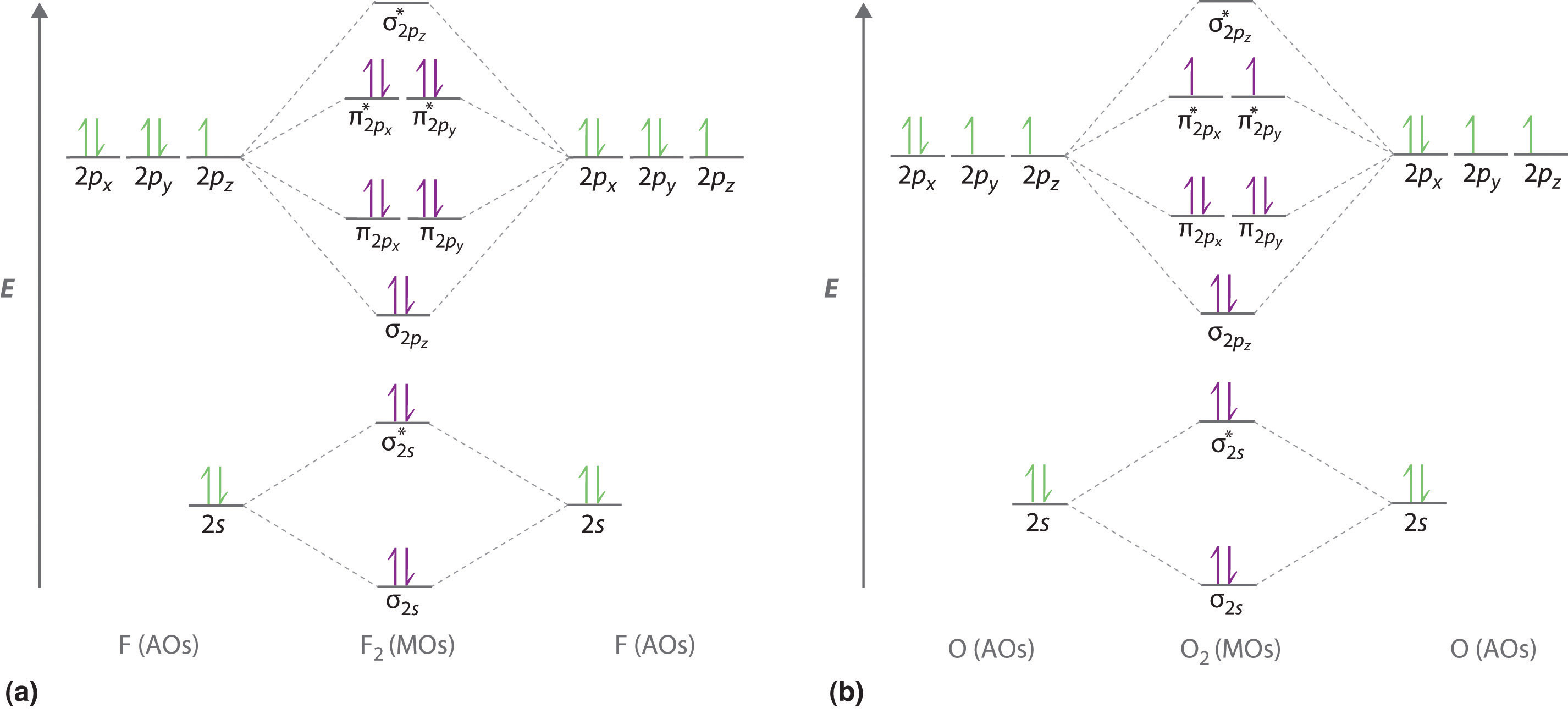
4.10: Second-Row Diatomic Molecules - Chemistry LibreTexts
For example, an ns/ns overlap for a homonuclear diatomic molecule gives rise to a partial MO diagram like this: and an np/np overlap for O2 and F2 gives: So, the full MO diagram is: Thus, the valence electron configuration is: (σ2s)2(σ* 2s)2(σ2pz)2(π2px)2(π2py)2(π* 2px)2(π* 2py)2. Answer link.
What is the molecular orbital diagram of O2 and F2? - Quora
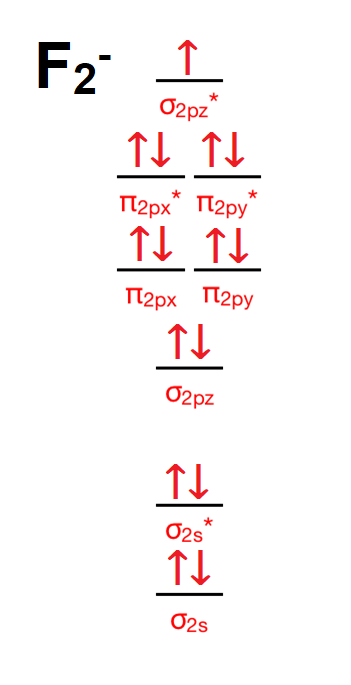
Concept: Molecular Orbital Diagrams of Homonuclear Diatomics Example: Using a Molecular Orbital (MO) diagram, write the electron configuration for the difluorine anion, F2-. Home
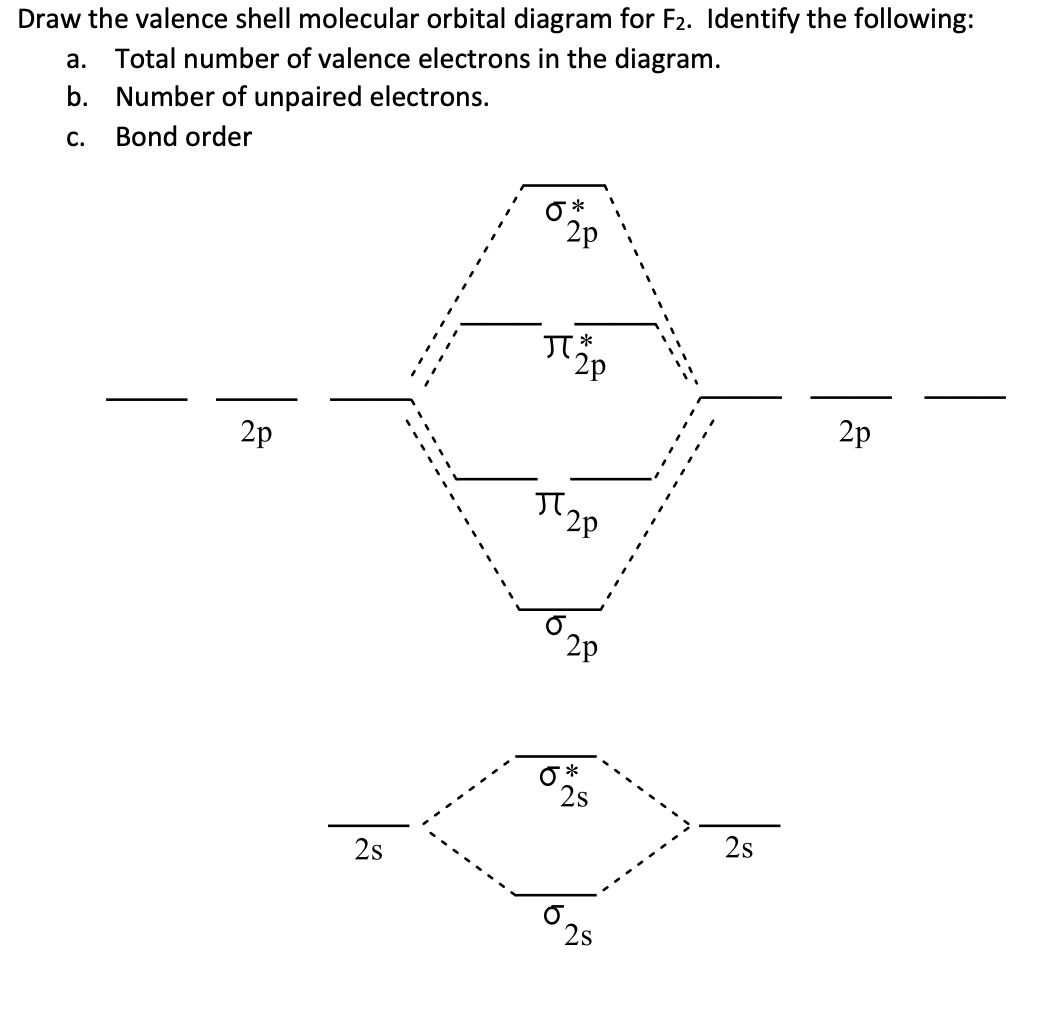
Solved Draw the valence shell molecular orbital diagram for ...
Now, let us draw the molecular orbital diagram of ${N_2}$ . Now, first let us understand what magnetic behavior and bond order means. - Magnetic behavior: As we know the electron has an electron magnetic dipole moment, which is generally generated by the electron's spin property, which induces an electric charge into motion. As we can see the ...
Predicted organic compounds derived from rare gas atoms and ...
Molecular orbital diagram and bond order of fluorine molecule . Fluorine molecule is formed by the combination of atomic orbitals of two fluorine atoms, each having nine electrons, thus making 18 electrons.; These 18 electrons are filled in various molecular orbitals, in the increasing order of their energies (aufbau principle) and on the basis of Hund's rule and Pauli's exclusion principle as ...

1.2. The molecular orbital diagrams of a) O 2 − doublet (n ...
Arrange the following in order of decreasing stability. a blank molecular orbital diagram (part a 1 figure) has been provided to you. rank the fluorine species from most to least stable. to rank items as equivalent, overlap them. f2, f2+, f2-
CHAPTER 5: MOLECULAR ORBITALS
When two fluorine atoms bond, the sigma(2p) bonding molecular orbitals are lower in energy than the pi(2p) bonding orbitals.F2(2+) has a bond order of 2, so ...
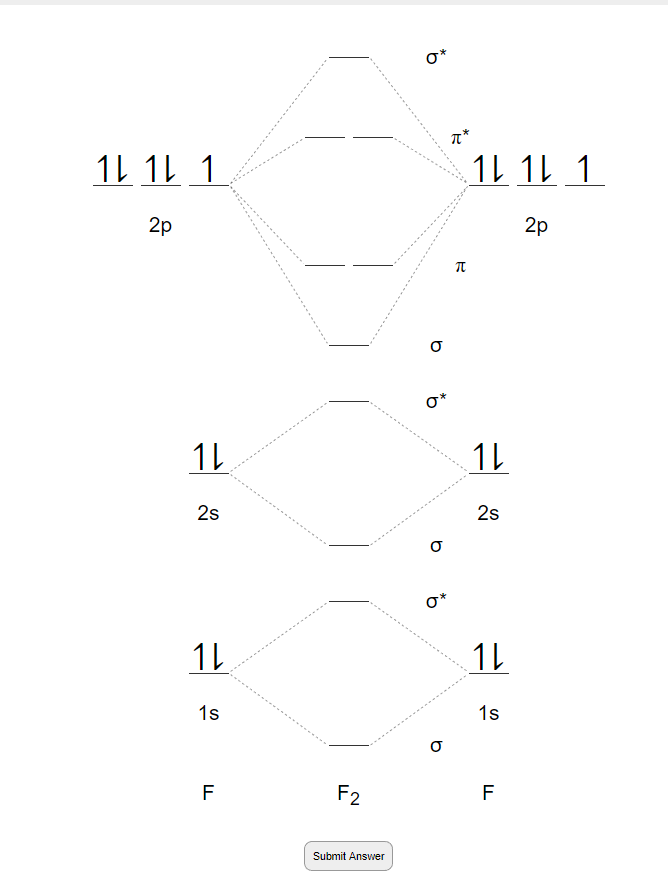
Solved Instructions: Construct the molecular orbital diagram ...
Click here to get an answer to your question how to drew molecular orbital diagram of Cl2. bond order = 1 (like F2) Cl2 has the weakest bond. b. + would be weaker than in Cl2, the Ar-Ar distance would be molecular orbitals in the diagram suggest. Cl atom has 17 electrons, so chlorine molecule has (Cl2) has 34 electrons. so, bond order of ...

Draw an MO diagram for the valence electro... | Clutch Prep
Molecular orbital (MO) diagram for N2 and N2^- $-$\mathrm{p}$ interaction moving from $\ce{Li2}$ to $\ce{F2}$. The $\mathrm{s}$-$\mathrm{p}$ interaction is the bonding interaction between the $\mathrm{2s}$ orbital of one atom and the $\mathrm{2p_{z}}$ orbital of another atom which (among other things) increases the energy of the $\mathrm ...
Principles of Chemical Science, Solutions for Lecture 13 ...
For the ion F2+:a) Draw the molecular orbital diagram.b) Calculate the bond order.c) Would this ion exist?d) Write the electron configuration of the ion.————...
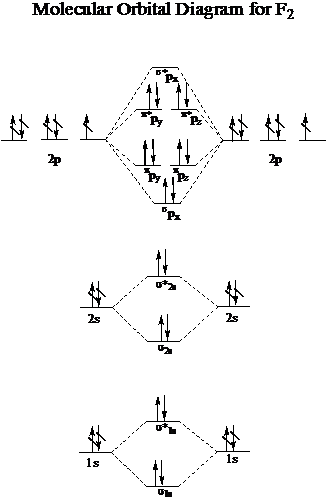
Question #253e2 | Socratic
This video is about MO Diagram #2 - F2

What is the bond order of F22- according to molecular orbital ...
Answer (1 of 6): Here is the solution, > * For O2 molecule, > * For F2 molecule, Thanks for reading.

What is the bond order of f2 and it's molecular orbital ...
A molecular orbital diagram, or MO diagram, is a qualitative descriptive tool explaining chemical bonding in molecules in terms of molecular orbital theory in general and the linear combination of atomic orbitals (LCAO) method in particular. A fundamental principle of these theories is that as atoms bond to form molecules, a certain number of atomic orbitals combine to form the same number of ...

Molecular orbital diagram with the orbital energy gap and ...
MO Diagram for HF The AO energies suggest that the 1s orbital of hydrogen interacts mostly with a 2p orbital of fluorine. The F 2s is nonbonding. H-F nb σ σ* Energy H -13.6 eV 1s F -18.6 eV -40.2 eV 2s 2p So H-F has one σ bond and three lone electron pairs on fluorine

Write a correct molecular orbital diagram for each of the ...
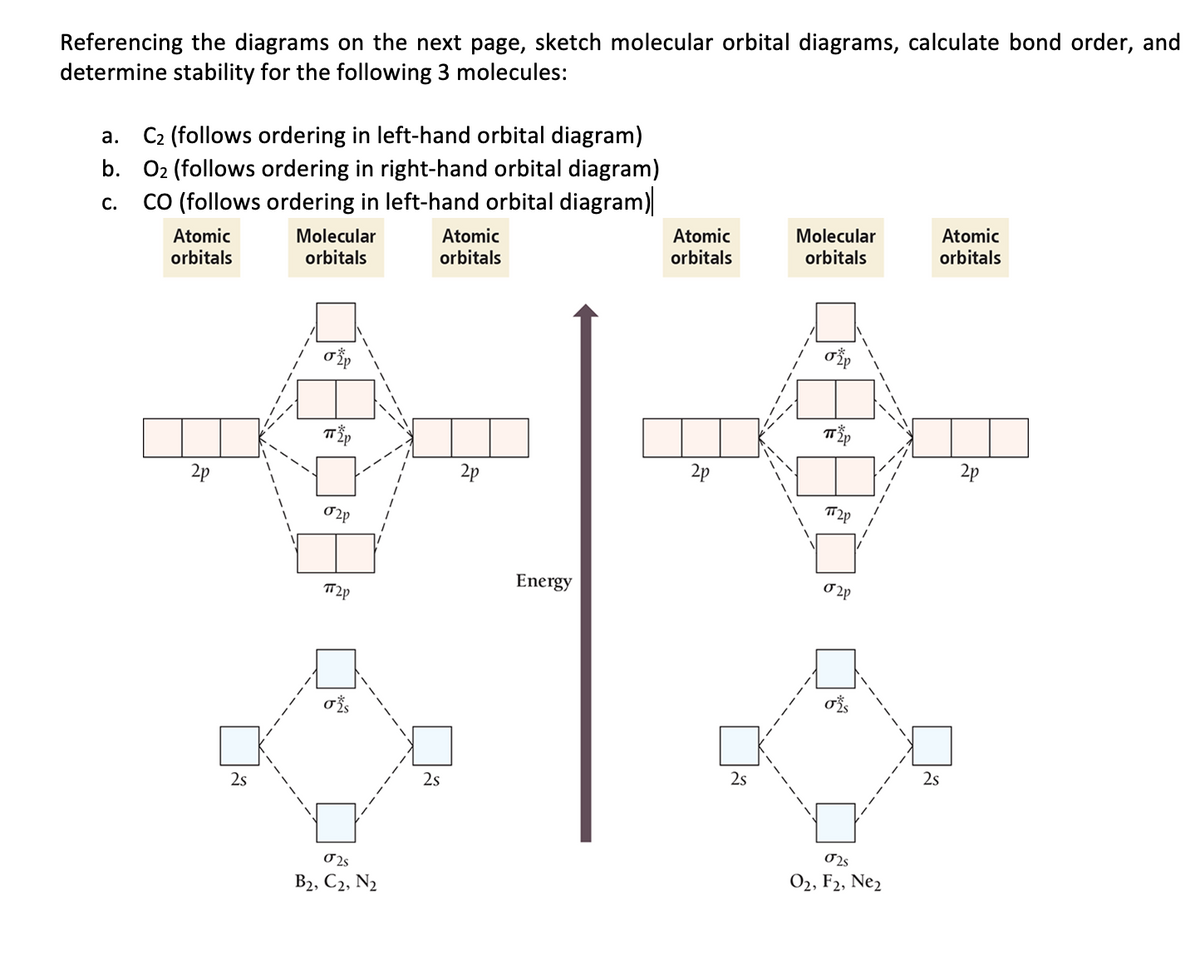
Even rather simple molecular orbital (MO) theory can be used to predict from the bottom of the diagram because this is how MO diagrams are constructed, from N2, O2, F2, Ne2 the complexity of the molecular orbitals develop in two ways. Page 1. MO Diagrams for Elements Li2 through Ne2. (Don't memorize.) Li2 through N2. O2 through Ne2.

Determine the bond order from the molecula... | Clutch Prep
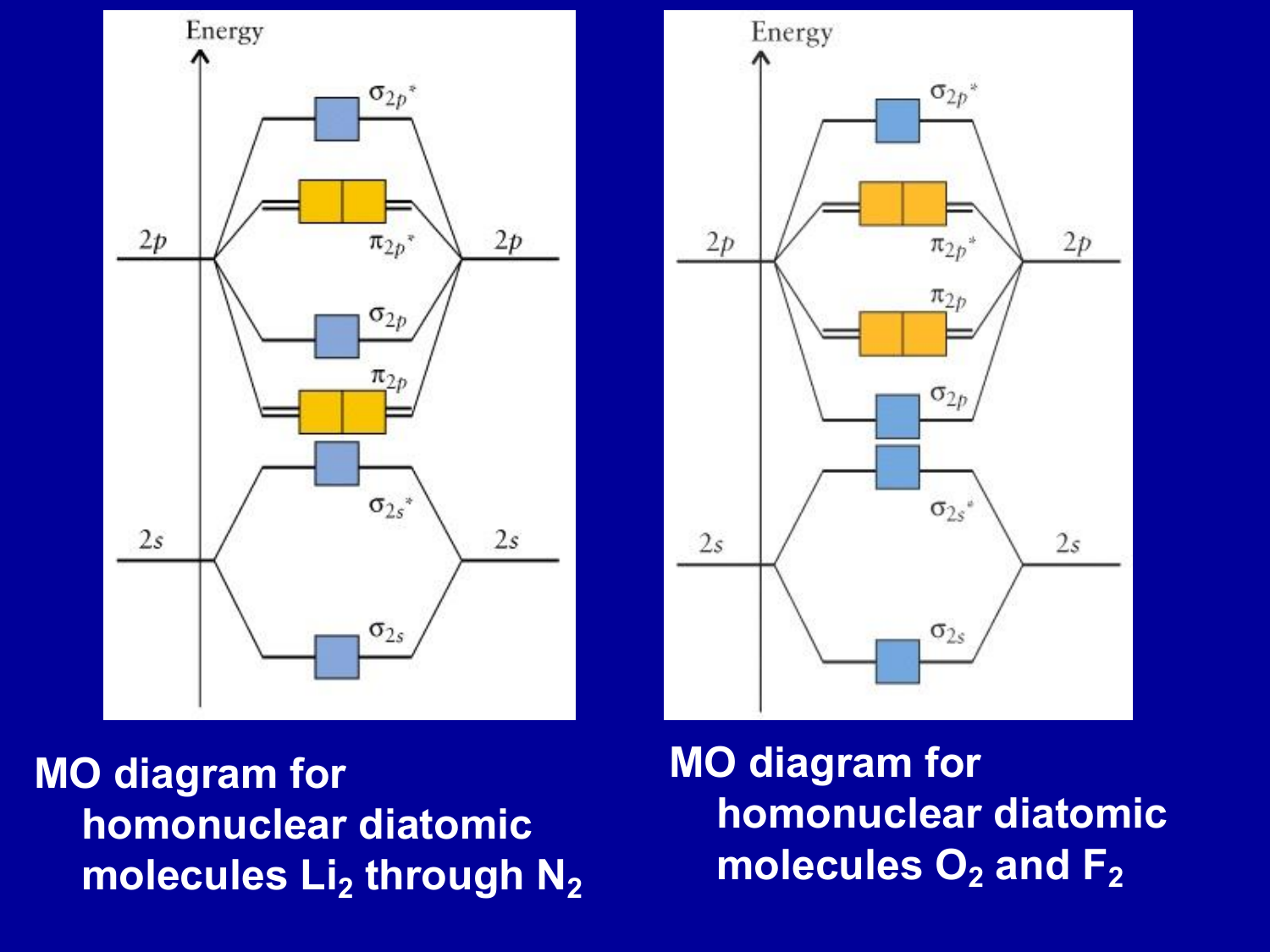
MO diagram for homonuclear diatomic molecules O and F
ENERGY LEVELS FOR HOMONUCLEAR DIATOMIC MOLECULES What do I ...
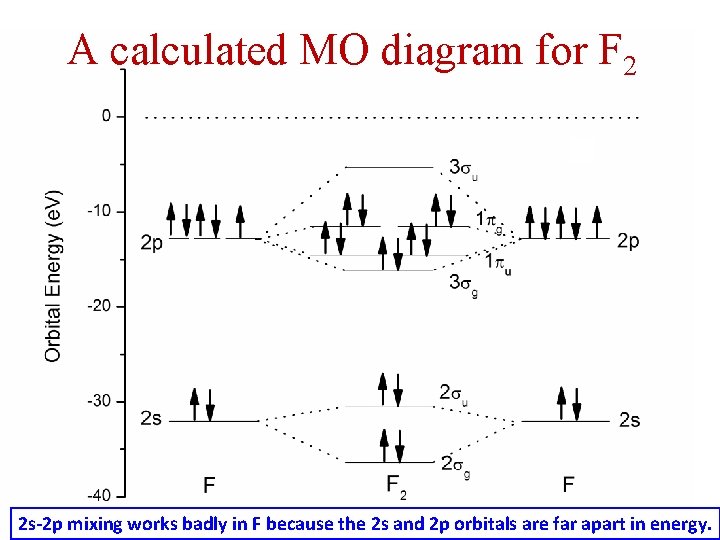
Molecular Orbital Theory presented by Michael Morse University
CHEMISTRY XL-14A MOLECULAR SHAPE AND STRUCTURE - ppt video ...

CBSE Class 11 - Molecular Orbital diagram-part 2 Offered by ...
Draw an MO diagram for the valence electro... | Clutch Prep
Molecular Orbitals | Introductory Chemistry

a. Draw the molecular orbital diagram shown to determine ...
Use the molecular orbital energy level diagram to show that ...
DO NOT OPEN

Molecular Orbital (MO) Diagram for F2(2+)
ENERGY LEVELS FOR HOMONUCLEAR DIATOMIC MOLECULES What do I ...
PPT - Molecular Orbital Theory PowerPoint Presentation, free ...
Answered: C2 (follows ordering in left-hand… | bartleby
PPT - Bonding III PowerPoint Presentation, free download - ID ...
Bonding in Simple Diatomic Molecules
What is the molecular orbital diagram of O2 and F2? - Quora
Molecular orbitals in Fluorine
CHAPTER 5: MOLECULAR ORBITALS

MO Diagrams for First Row Diatomic Molecules - Chemistry ...
What is the molecular orbital diagram of O2 and F2? - Quora

9.3: Molecular Orbital Theory - Chemistry LibreTexts

Use the molecular orbital diagram shown to determine which of ...
CHAPTER 5: MOLECULAR ORBITALS

Valence Bond (VB) and Molecular Orbital (MO) Theories - ppt ...


Comments
Post a Comment