43 carbon mo diagram
September 21, 2016 - I had to give this a good, long thought, after I initially thought this is a question which is hardly answerable with a molecular orbitals diagram by itself. Now that I have spent quite some time thinking about it, I must admit I enjoy this exercise a lot. The key to explaining that carbon monoxide ... Carbon sulfide (CS) More... Molecular Weight: 44.08. Dates: Modify . 2022-01-01. Create . 2005-03-27. Carbon monosulfide is an organosulfur compound. ChEBI. Contents. 1 Structures Expand this section. 2 Names and Identifiers Expand this section. 3 Chemical and Physical Properties Expand this section.
Molecular orbitals for CO2 using the pictorial method. Here I look at determining the symmetries of the possible combinations of orbitals. Part 2 will look...
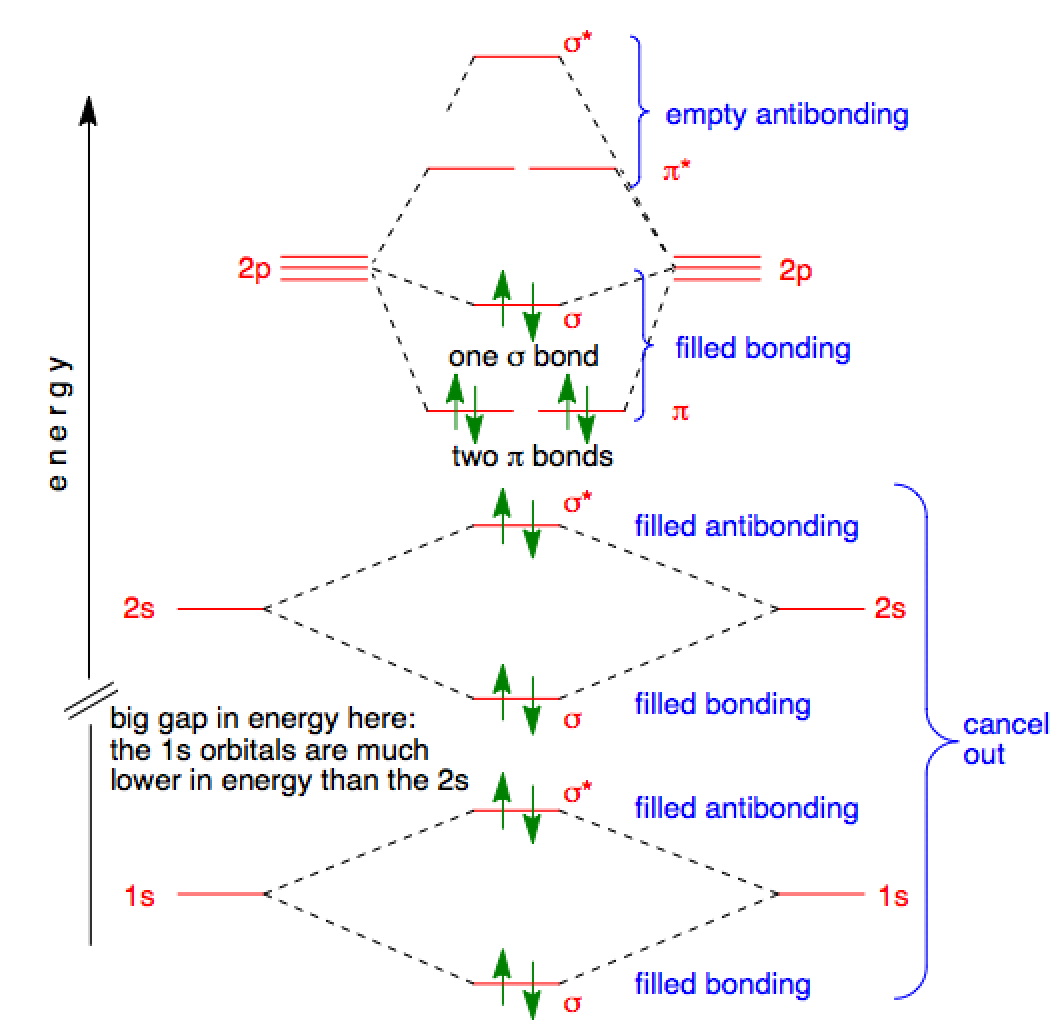
Carbon mo diagram
In this video we will draw the molecular orbital diagrams for diatomic nitrogen, carbon and boron. We will also calculate their bond order and determine if t... Carbon dioxide (CO2), molecule is triatomic and linear like Beryllium di hydride (BeH2) However, unlike hydrogen as peripheral atoms in BeH2, there are oxyge... The MO models shown on this web page were obtained at the RHF/3-21G* level in a conventional ab initio calculation, using a Gaussian atomic basis set; This is an approximation to Natural Atomic Orbitals, 2s, 2p z, etc., which are not very amenable to computation; A Natural Bond Orbital analysis of the resulting MOs produced a set of NAOs and the coefficients of these needed to make the ...
Carbon mo diagram. There are two MO diagrams you need to memorize for diatoms (N2, O2, Ne2, etc) . One is for the elements up to Nitrogen. The other is for AFTER nitrogen. The correlation diagrams for nitrogen and carbon monoxide and the first are nearly parallel to the corresponding orbital energy curves. Interpreting the MO Diagram of Carbon Monoxide - YouTube The carbon monoxide MO isosurfaces are analyzed and assigned to the energy levels in the MO diagram. An attepmt is made to assign these... #3. Draw the MO diagram for `O_2^+` This is a bit of a curveball, but a perfectly valid problem. Recall that a cation indicates a loss of `1` electron. `O_2^+` is just the ionized form of `O_2`; that is, it's `O_2` with `1` missing electron. The MO diagram will be the same as the MO diagram of `O_2`, except with `1` less electron. Oct 26, 2017 - Interactive 3D chemistry animations of reaction mechanisms and 3D models of chemical structures for students studying University courses and advanced school chemistry hosted by University of Liverpool
This webcast gives a qualitative description of constructing the MO diagram for carbon monoxide, a heterodiatomic molecule in which the AO energies are not m... Enjoy the videos and music you love, upload original content, and share it all with friends, family, and the world on YouTube. 8 - Drawing Molecular Orbital Diagrams. Abstract (TL;DR) Molecular orbital diagrams are a fantastic way of visualizing how molecular orbitals form using what we already understand about sigma and pi bonds. Depending on if it is a homonuclear case, where the bonding atoms are the same, or a heteronuclear case, where the bonding atoms are ... Answer (1 of 3): The atomic orbitals of oxygen are uniformly lower in energy than the corresponding atomic orbitals of element C because of the increased stability of the electrons in oxygen. The molecular orbitals are no longer symmetrical, and the energies of the bonding molecular orbitals are ...
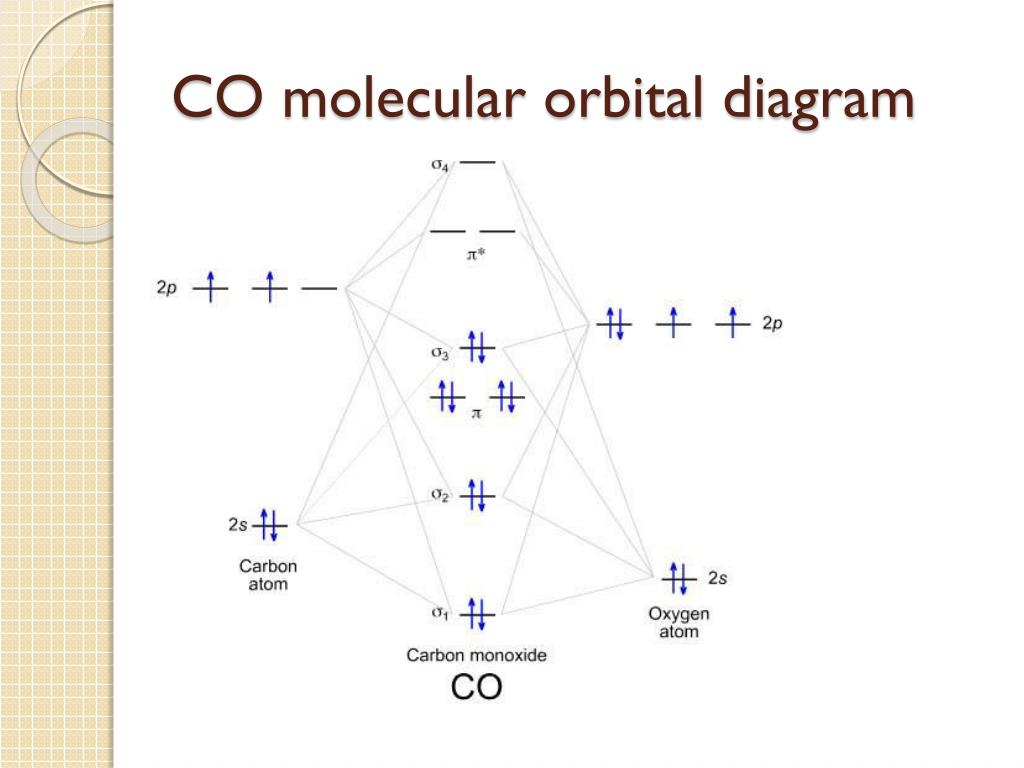
Carbon monoxide (chemical formula CO) is a colorless, odorless, tasteless, flammable gas that is slightly less dense than air.Carbon monoxide consists of one carbon atom and one oxygen atom. It is the simplest molecule of the oxocarbon family. In coordination complexes the carbon monoxide ligand is called carbonyl.It is a key ingredient in many processes in industrial chemistry. IN THIS VIDEO I HAVE DISCUSSED ABOUT THE MOLECULAR ORBITAL DIAGRAM OF CO WHICH IS THE MOST IMPORTANT LIGAND IN ORGANOMETALICS AND COORDINATION CHEMISTRY.CON... Molecular Orbital Diagram of Carbon Monoxide (CO) The above image shows energy levels for the molecular orbitals of the carbon monoxide (CO) The molecular orbital diagram is a diagrammatic representation of showing how chemical bonding is taking place within a molecule. mo diagram of pie bonded molecule Follow me on instagram- https://www.instagram.com/trickychemistrysuman/?hl=en Follow me on facebook page- https://lm.facebo
Molecular orbitals in Nitrogen
There are 4 electrons in the outer shell of carbon and 6.A molecular orbital diagram, or MO diagram, is a qualitative descriptive tool explaining chemical bonding in molecules in terms of molecular orbital theory in general and the linear combination of atomic orbitals (LCAO) molecular orbital method in particular.

Image from page 75 of "Florists' review [microform]" (1912)
What is molecular orbital diagram of CO? Carbon monoxide MO diagram. Carbon monoxide is an example of a heteronuclear diatomic molecule where both atoms are second-row elements. The valence molecular orbitals in both atoms are the 2s and 2p orbitals. The molecular orbital diagram for carbon monoxide (Figure 5.3.
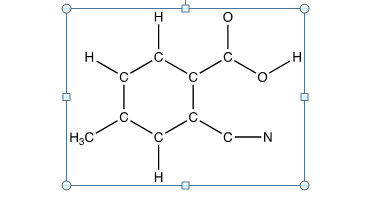
Carbon Monoxide Molecular Orbital Diagram - Drivenheisenberg
Carbon Dioxide MO Diagram Carbon dioxide (CO2) molecular orbital diagram (Jmol visualization) for important MOs. The HOMO-1, HOMO and LUMO+1 are degenerate and the HOMO-5, HOMO-4 and HOMO are non-bonding lone pairs. Firefly 8.2.0 DFT B3LYP 6-311++G (d,p) geometry-optimized structure (energy minimum, no imaginary frequencies).

British Library digitised image from page 218 of "The World: historical and actual. What has been and what is ... Together with ... charts, reference tables ... from B.C. 1500, to the present time. Numerous ... illustrations"
Carbon Monoxide Molecular Orbital Diagram Explanation. generic s-p valence MO diagram for carbon monoxide CO chain one can reasonably explain, that the HOMO of carbon monoxide must be of. A molecular orbital diagram, or MO diagram, is a qualitative descriptive tool explaining MO diagrams can explain why some molecules exist and others do not.

35 Molecular Orbital Diagram For Co - Wiring Diagram List
January 21, 2020 - mo diagram co2 molecular orbital ... order Molecular Orbital Diagram – Quantum‐mechanical Condensed Matter Simulations With Crystal Wires the mo diagram of carbon monoxide this webcast gives a qualitative description of constructing the mo diagram for carbon monoxide a ...

Carbon Monoxide Molecular Orbital Diagram Of Co - Diagram ...
A molecular orbital diagram, or MO diagram, is a qualitative descriptive tool explaining chemical bonding in molecules in terms of molecular orbital theory in general and the linear combination of atomic orbitals (LCAO) molecular orbital method in particular. Now carbon monoxide's MO diagram is: Hope it helps :) 59.4K views.

Carbon Monoxide Molecular Orbital Diagram - Wiring Diagram
Relative AO Energies in MO Diagrams Use AO energies to draw MO diagram to scale (more or less). H He Li Be B C N O F Ne B C N O F Ne Na Mg Al Si P S Cl Ar Al Si P S Cl Ar 1s 2s 2p 3s 3p –19.4 eV –15.8 eV –32.4 eV –10.7 eV

Image from page 225 of "Railway mechanical engineer" (1916)
March 16, 2020 - Click on the CO molecular orbitals in the energy level diagram to display the shapes of the orbitals ... Hydrogen | Fluorine | Nitrogen | Hydrogen Fluoride | Carbon Monoxide | Methane | Ammonia | Ethylene | Acetylene | Allene | Formaldehyde | Benzene

Emu of the Ozarks
MO-Diagram for the first 10 elements: Works great for O 2-> explains O 2's paramagnetism But predicts B 2 to be diamagnetic-> Orbital Mixing! 5.2 Homonuclear Diatomic Molecules 5.2 Homonuclear Diatomic ... 5.4.2 Carbon Dioxide's Molecular Orbital Diagram

Building
Molecular Orbital Diagram for Carbon Dimer (C2). Fill from the bottom up, with 8 electrons total. Bonding Order is 2, and it is Diamagnetic. sigma2s(2),sigma...

Ni-Superalloy, as-extruded microstructure
Re: MO diagram and Lewis Structure of CO Post by 104277942 » Fri Dec 06, 2013 7:36 am For bond order it is a good rule of thumb that triple bonds = 3 double = 2 and single = 1 but if you want to be sure, I personally like drawing a quick MO diagram sketch on the side and do the formula (bonding-antibonding)/2 to find the bond order if I am not ...

Red roses on rose bushes by Vicksburg Station Lake.
2 Lecture 2 Pi bond (π): bonding molecular orbital -The bonding electron density lies above and below, or in front and in back of the bonding axis, with no electron directly on the bonding axis, since 2p orbitals do not have any electron density at the nucleus.
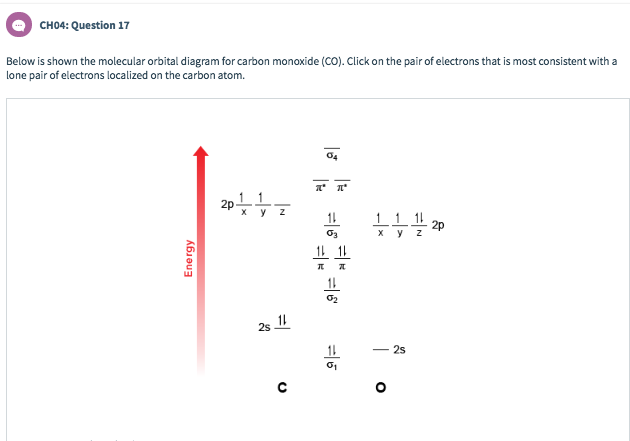
Solved: Below Is Shown The Molecular Orbital Diagram For C ...
For a diatomic molecule, an MO diagram effectively shows the energetics of the bond between the two atoms, whose AO unbonded energies are shown on the sides. For simple polyatomic molecules with a "central atom" such as methane ( CH 4) or carbon dioxide ( CO 2 ), a MO diagram may show one of the identical bonds to the central atom.
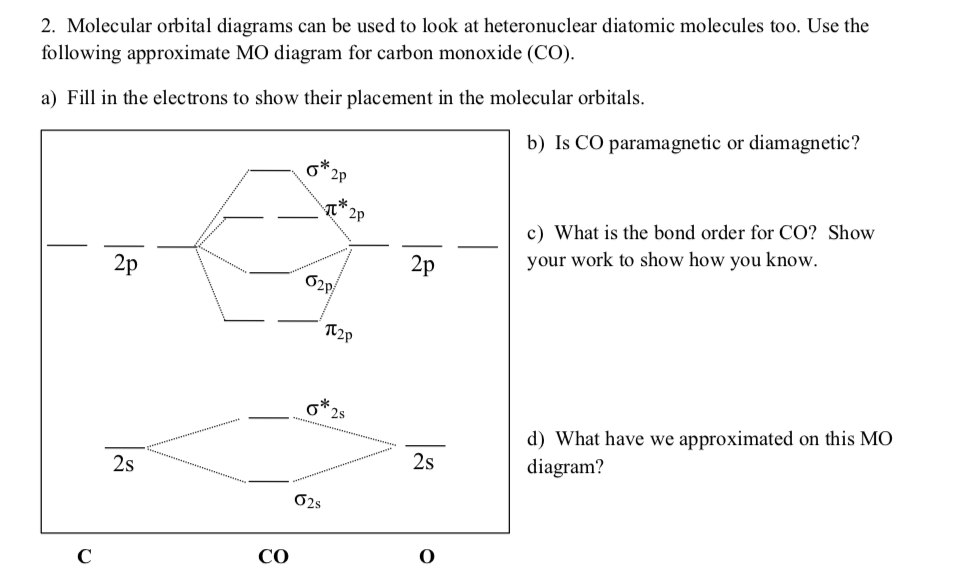
Molecular Orbital Diagram Of Co - Ekerekizul
Access 130+ million publications and connect with 20+ million researchers. Join for free and gain visibility by uploading your research.

Busy bee on a blossom.
12-12 This video describes the molecular orbital theory diagram of CO, placing emphasis on how MO theory differs for homo and heteronuclear diatomics

26 Carbon Monoxide Mo Diagram - Wiring Diagram Niche
Answer (1 of 3): The atomic orbitals of oxygen are uniformly lower in energy than the corresponding atomic orbitals of element C because of the increased stability of the electrons in oxygen. The molecular orbitals are no longer symmetrical, and the energies of the bonding molecular orbitals are ...
What is the bond order of CO? - Quora
4) or carbon dioxide(CO 2), a MO diagram may show one of the identical bonds to the central atom. For other polyatomic molecules, an MO diagram may show one or more bonds of interest in the molecules, leaving others out for simplicity.
基于增强相构型设计的石墨烯/Cuå¤åˆææ–™ç ”ç©¶è¿›å±•
The molecular orbital diagram of carbon monoxideis very similar to that of molecular nitrogen. Carbon, with 4 valence electrons, and oxygen with 6 valence electrons, together have the same number of electrons as dinitrogen.

PPT - MO Diagrams for Linear and Bent Molecules PowerPoint ...
MO Diagram for HF The AO energies suggest that the 1s orbital of hydrogen interacts mostly with a 2p orbital of fluorine. The F 2s is nonbonding. H–F nb σ σ* Energy H –13.6 eV 1s F –18.6 eV –40.2 eV 2s 2p So H–F has one σ bond and three lone electron pairs on fluorine

Dew-laden spiderwebs on a foggy autumnal morning, 2008
6. Finally, add the valence electrons to the molecular orbital diagram. Each carbon has 4 and each hydrogen 1 for a total of 12 electrons. Ethyne, sp hybridization with two pi bonds 1. 2. Ethyne, HCCH, is a linear molecule. Each carbon atom makes 2 sigma bonds and has no lone pairs of electrons. 3.
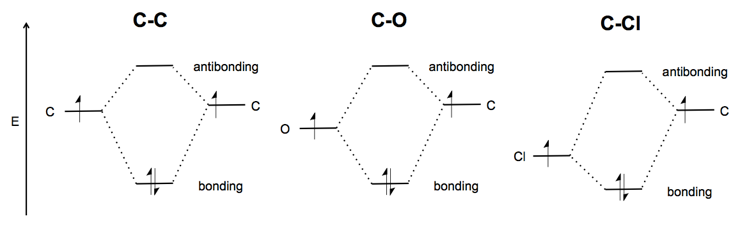
Organic chemistry 04: Arrow-pushing: resonance ...
The problem provides you with the MO diagram for the #"C"_2# molecule, so all you really have to do here is add an electron to that diagram.. You need to add an electron and not remove one because of the overall negative charge that exists on the molecule. As you know, a neutral carbon atom has a total of #6# electrons.. This, of course, implies that a #"C"_2# molecule has a total of

Phase Diagrams: Critical Point, Triple Point and Phase ...
The geometry of this molecule about the C atom is trigonal planar, with 120 degrees separating each of the 3 sigma bonds. The carbon atom therefore hybridises ...4 answers · 29 votes: First let us know what molecular orbital diagram is: A molecular orbital diagram, or MO diagram, ...
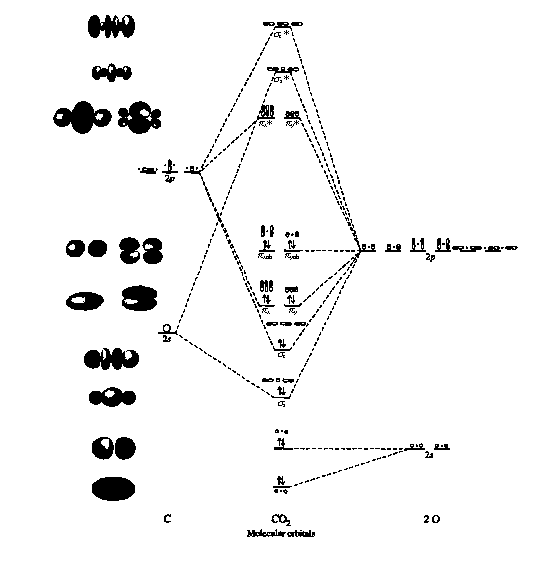
CO2 molecular orbitals
This video is meant to strengthen the basics of chemistry.
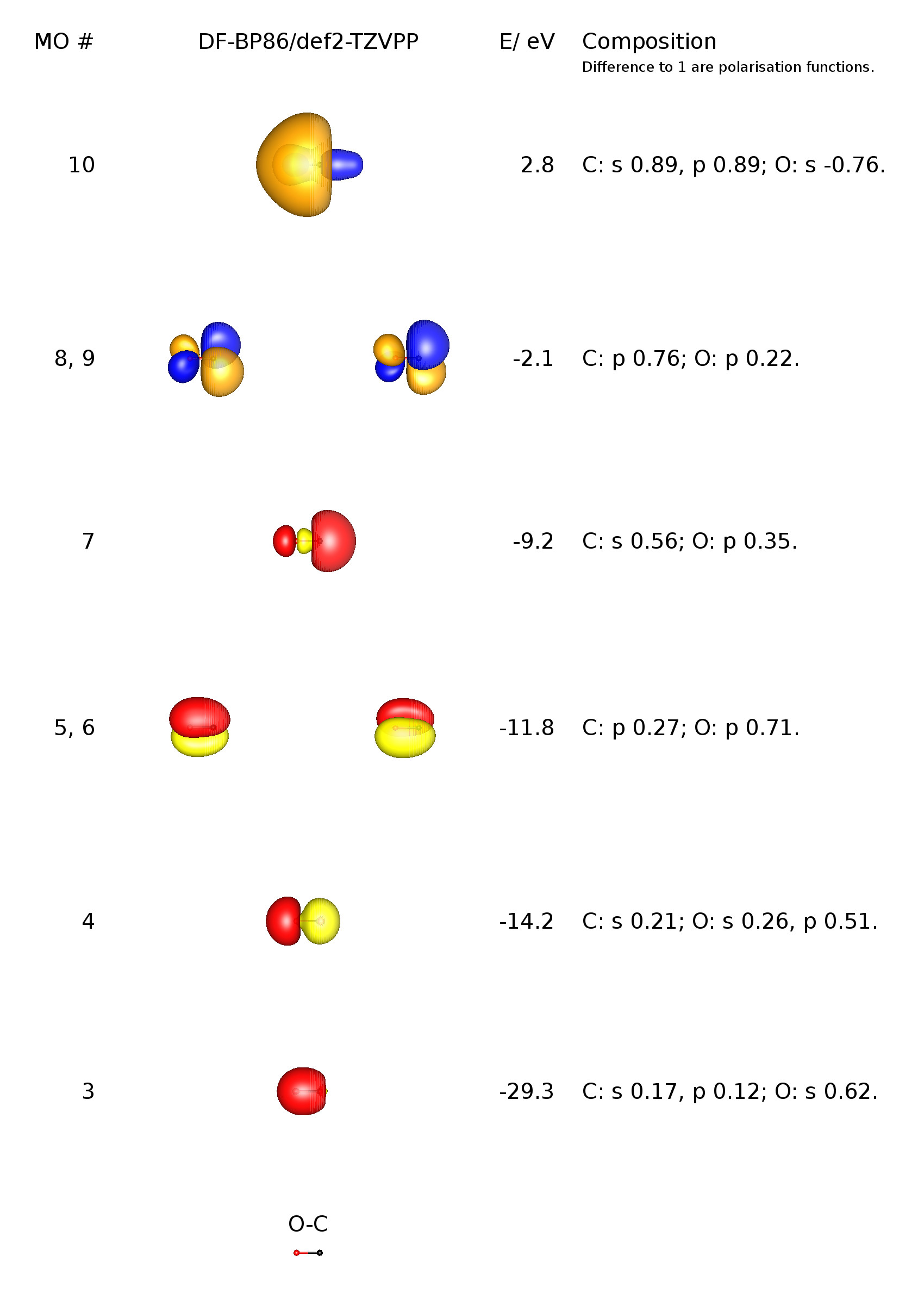
Carbon Monoxide Molecular Orbital Diagram Explanation
March 19, 2021 - Carbon monoxide is an example of a heteronuclear diatomic molecule where both atoms are second-row elements. The valence molecular orbitals in both atoms are the \(2s\) and \(2p\) orbitals. The molecular orbital diagram for carbon monoxide (Figure \(\PageIndex{1}\)) is constructed similarly ...

physical chemistry - Molecular orbital treatment of carbon ...
1. MO's of the Allyl System (Radical, Cation, and Anion). The allyl system is a three carbon system in which the carbon atoms are all sp 2 hybridized, and the trigonal planes are all coincident, so that the unhybridized 2p z AO's are all "parallel" and undergoing efficient pi overlap. Since all three atoms are involved
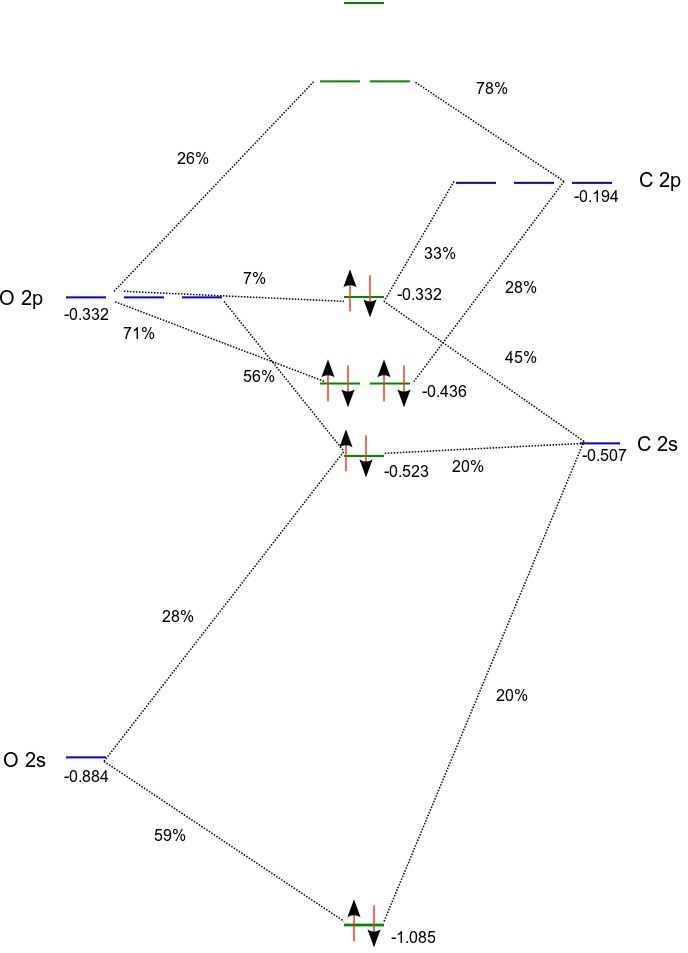
A TDDFT study of carbon monoxide — DIRAC 12.7 documentation
Draw MO diagram of CO and calculate its bond order. chemical bonding; class-11; Share It On Facebook Twitter Email. 1 Answer +1 vote . answered Dec 17, 2020 by Maisa (45.7k points) selected Dec 18, 2020 by Panna01 . Best answer. 1. Electronic configuration of C atom: 1s 2 2s 2 2p 2. ...
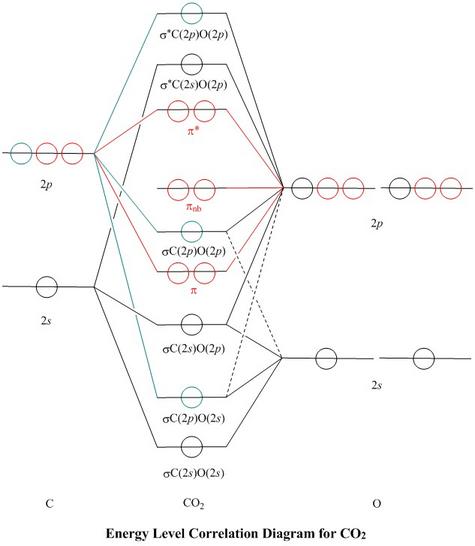
Molecular Orbitals for CO2
The MO diagram for the diatomic carbon monoxide, CO, shows it to be isoelectronic with nitrogen, N 2: The heteronuclear diatomic ions cyanide ion, CN -, and nitrosonium ion, NO +, are also electronic with nitrogen, N 2, and carbon monoxide. The only difference between the MO diagrams are the relative energies of the orbitals.

PPT - MO Diagrams for Linear and Bent Molecules PowerPoint ...
The electron configuration for carbon and oxygen are: C : [He] 2s ² 2p² → 4 valence electrons; O : [He] 2s ² 2p⁴ → 6 valence electrons; There are a total of 10 electrons for carbon monoxide (CO) for which we can fill the MO diagram starting from the lowest-energy MO to the highest-energy MO.

Carbon Monoxide Molecular Orbital Diagram - General Wiring ...
Benzene Molecular Orbital (MO) Diagram A molecular orbital (MO) diagram explains the chemical bonding in molecules by energy level diagrams. They were proposed by Robert S. Mulliken and Friedrich Hund in 1928. The postulates of MO theory are as follows- Electrons present in molecular orbitals of a molecule are considered.
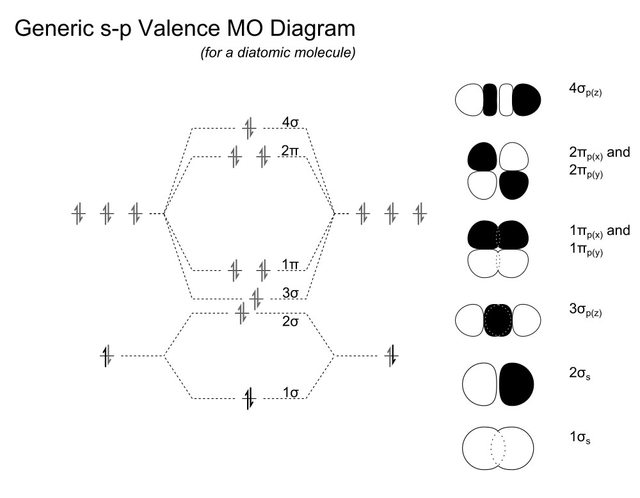
orbitals - How to rationalise with MO theory that CO is a ...
In order to understand the bonding in metal carbonyls, let us first see the MO diagram of carbon monoxide. Figure: Molecular Orbital Energy Level Diagram of Carbon Monoxide . The order of energy of the molecular orbitals and the accommodation of ten electrons of the
C2h4 Molecular Orbital Diagram
March 2, 2021 - The carbon dioxide MO diagram is based on a C atom and an O--O ligand fragment. Carbon has 2S and 2Px,y,z orbitals and the O--O fragment has 2S and 2Px,y,z orbitals that are involved in the formation of molecular orbitals. Since CO2 has D∞h symmetry the central atom's orbital symmetry lables ...
Carbon Monoxide MO diagram - The Student Room
The MO models shown on this web page were obtained at the RHF/3-21G* level in a conventional ab initio calculation, using a Gaussian atomic basis set; This is an approximation to Natural Atomic Orbitals, 2s, 2p z, etc., which are not very amenable to computation; A Natural Bond Orbital analysis of the resulting MOs produced a set of NAOs and the coefficients of these needed to make the ...

Parison Between Silicon And Carbon - Molecular Orbital ...
Carbon dioxide (CO2), molecule is triatomic and linear like Beryllium di hydride (BeH2) However, unlike hydrogen as peripheral atoms in BeH2, there are oxyge...

Carbon Monoxide Molecular Orbital Diagram - Wiring Diagram ...
In this video we will draw the molecular orbital diagrams for diatomic nitrogen, carbon and boron. We will also calculate their bond order and determine if t...

Carbon Dioxide Molecular Orbital Diagram - Diagram Media

Interpreting the MO Diagram of Carbon Monoxide - YouTube

Molecular Structure: Atomic Orbitals

Image from page 113 of "The American natural history : a foundation of useful knowledge of the higher animals of North America " (1906)
PPT - M-CO and M-PR 3 Bonds PowerPoint Presentation, free ...

Mo-C phase diagram [29]. | Download Scientific Diagram

What is an atom? - It's a Question of Physics - The Atomic ...

X-ray photoelectron spectroscopy (XPS) spectra of Mo 3d ...

(left) Simplified MO diagram of CO with electronic ...


Comments
Post a Comment